Published: 9 Oct 2026


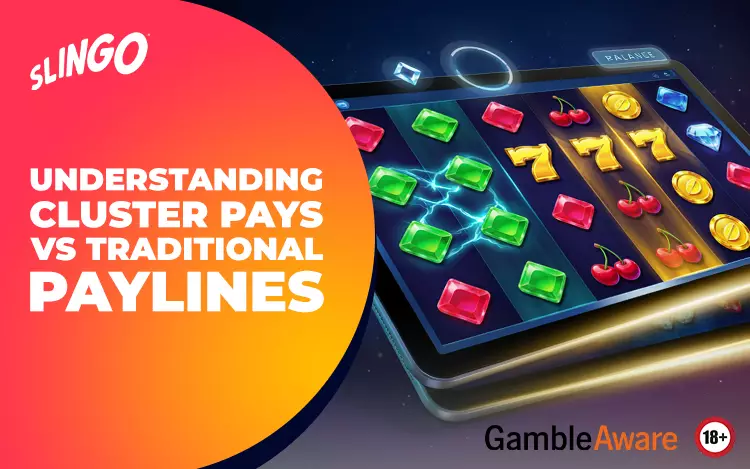

Slot games don't all calculate winning combinations in the same way. While many use traditional paylines, others rely on connected symbol clusters instead. These different mechanics influence how winning combinations are formed, how symbols interact and how the gameplay unfolds.
Traditional paylines have been a familiar feature of slot games for decades, with matching symbols needing to land along specific lines to create a win. Cluster Pays slots take a different approach, allowing groups of matching symbols to form winning combinations without following fixed patterns. Both mechanics offer distinct gameplay experiences, giving players different ways to enjoy their favourite slot games.
Understanding Cluster Pays slots and how they compare with traditional paylines can help you recognise why different games feel and play differently. In this guide, we'll explore how each mechanic works, their key differences and what to consider when choosing a slot game that suits your preferences.
*Terms and conditions apply.*
Traditional paylines explained
Traditional slots use predefined lines across the reels to determine winning combinations.
A winning combination is formed when matching symbols land on one of these active paylines. Depending on the game, there may be a single payline or hundreds of ways for paylines to run across the reels.
Although the layouts vary, the principle stays the same. Symbols must land in the correct positions to create a qualifying combination.
If you're exploring online slots, you'll find that many classic and modern titles still use traditional paylines.
|
Traditional Paylines |
Cluster Pays |
|
Fixed winning lines |
Connected symbol groups |
|
Matches follow set patterns |
Matches form adjacent clusters |
|
Common on reel-based slots |
Often found on grid layouts |
|
Familiar gameplay style |
Alternative game mechanic |
How Cluster Pays works
Rather than following fixed paylines, Cluster Pays games reward groups of matching symbols that touch each other horizontally or vertically.
This removes the need for predefined winning lines and creates a different style of gameplay. Instead of watching specific paylines, players look for connected symbol groups across the grid.
Neither system is better than the other. They simply offer different ways of presenting winning combinations while remaining games of chance.
Slingo Tip: Before trying a new slot, open the paytable or help section. It explains exactly how winning combinations are formed.
Different mechanics create different experiences
The way a slot awards winning combinations has a noticeable effect on how the game feels.
Traditional paylines often provide a familiar rhythm that many players recognise. Cluster Pays games can feel more dynamic because winning groups may appear across different areas of the grid, especially when combined with other modern slot mechanics such as cascading symbols or expanding grids.
If you're curious about other modern formats, Megaways vs Cluster Pays Slots: Different Ways to Win compares two popular mechanics and explains how each creates its own style of gameplay without changing the fact that outcomes remain based on chance.
Modern slot mechanics keep evolving
Traditional paylines and Cluster Pays are just two examples of how slot design has changed over the years.
Developers continue to introduce new mechanics that give each game its own identity. Some combine Cluster Pays with cascading reels or expanding grids, while others use completely different formats.
The article slot mechanics explores how these systems influence gameplay and why different slots can feel so distinct.
Slingo Tip: If you're comparing two slot games, look beyond the theme. The game mechanic often has the biggest impact on how the experience feels.
Cluster Pays and Megaways aren't the same
Cluster Pays and Megaways are often mentioned together because both move away from traditional paylines, but they work in different ways.
Cluster Pays rewards connected groups of matching symbols, while Megaways changes the number of symbols on each reel to create varying numbers of possible winning ways.
The guide Megaways vs Cluster Pays explains these differences in greater detail, helping players understand how each mechanic creates a unique gameplay experience.
Which mechanic is right for you?
There's no single answer.
Some players enjoy the familiar structure of paylines, while others like the flexibility offered by Cluster Pays games. Personal preference often comes down to the style of gameplay, visuals and pace rather than the mechanic itself.
If you also enjoy online bingo, you'll notice that every game format has its own unique rhythm, making variety part of the overall entertainment.
Understanding the mechanics helps you choose
Learning how different slot mechanics work doesn't improve the likelihood of any particular outcome, but it can help you choose games that match your interests.
Whether you prefer traditional paylines or modern Cluster Pays games, all licensed slots use a Random Number Generator (RNG). Results are determined by chance, regardless of the mechanic used.
If you'd like to explore more game styles, browse Slingo games or visit Slingo for additional guides and information.
FAQs
What is a traditional payline?
A payline is a predefined pattern across the reels where matching symbols must land to create a winning combination.
How do Cluster Pays slots work?
Instead of paylines, Cluster Pays games reward groups of matching symbols that connect horizontally or vertically.
Is Cluster Pays better than paylines?
Neither mechanic is better. They simply create different gameplay experiences and appeal to different player preferences.
Does the game mechanic affect fairness?
No. Licensed slot games use Random Number Generators (RNGs), so outcomes remain based on chance regardless of whether the game uses paylines, Cluster Pays or another mechanic.
Can understanding slot mechanics predict results?
No. Knowing how a game works can help you understand its design, but it cannot predict future outcomes. Results are determined by a Random Number Generator (RNG). Outcomes are based on chance only.